Turkey, as a neighbor of Iraq and Syria, certainly needs a strong border control policy because of the terrorist threat stemming from instability and fragility in the region. In that regard, terrorist fighters and those who have been illegally passing the border are the biggest global threat for Turkey. To prevent their illegal mobilization, Turkey’s priority should be “strict border control”. In that regards, main measures aim at preventing the flow of FTFs and their reaching at the conflict zone and places where DAESH/ISIS has been dominated.
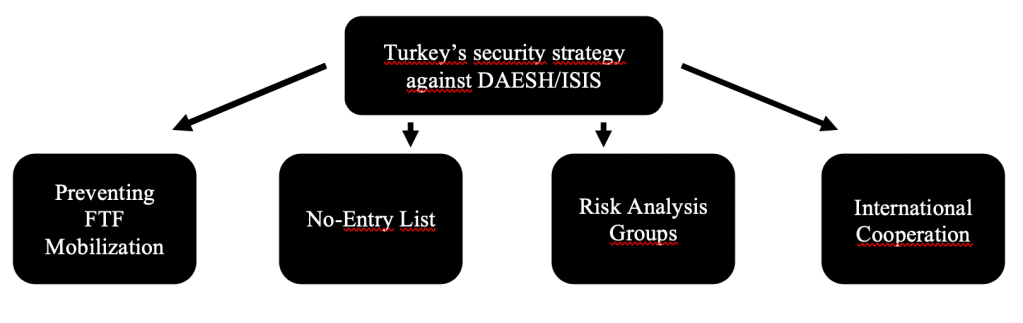
In places where conflicts and civil wars are mainly dominated, border security is the crucial principle of the security policy agenda. This principle mainly goals to prevent that terrorist fighters reach enough network to organize or plan terrorist attacks. Turkey strictly controls its border and implement certain border security policy. Under these circumstances, Turkey’s border policy is firstly focusing on airports and check in points in order to detect illegal passports and suspicious ones. It is important measure because of DAESH/ISIS locates just next to Turkey’s border and Turkey is affected at most. In that regard, Ministry of Interior has exerted utmost efforts through physical activities and disseminated reports to inform the people. In the light of this physical activities, “Risk Analysis Groups” which are active at border gates and stations are established to prevent illegal border crossing of FTFs and smuggling activities. According to the intelligence and information sharing process, these groups are effective at detecting smugglers, terrorist fighters, and who are related to DAESH/ISIS. Those groups are mainly focusing on asking questions related to their mobilization procedure and origin country to those who are suspicious. Related to the questions, those people are followed during their travel in Turkey after deciding whether to allow their entrance to Turkey or not. Under these circumstances, information sharing system among countries including Turkey is an important branch of the security policy. Turkish National Police is the main responsible authority from the border control and security to detect “hinder suspected” people. According to General Directorate of Police, those analysis groups are very efficient to prevent mobilization of terrorist fighters. Moreover, those groups and General Directorate of Migration Management measures are conducted hand in hand, which increase the counter terrorism policy’s efficiency. Thus, foreign nationals and suspicious people can be easily detected and deported.
Turkey has “patrol services” on its borders to detect those who are trying to illegally pass the border. Those terrorist fighters trying to illegally cross the border have faced with “physical barriers”, such as the wall construed on the Syrian border. Moreover, Turkey has strengthened these physical barriers through increasing number of officials working on the border. While deploying a great number of officials, a 32-km wall represents a certain deterrence element. Moreover, the number of soldiers who are deployed on the Syrian border reached 30 per cent of the Turkish Land Forces Command’s troops.[1] It is certain that Turkey has been a pivot in preventing dissemination of terrorist ideologies and mobilization of terrorist fighters.
Turkey’s another measure is to form “non-entry list”, database of which is shared with other countries to build strong deterrence mechanism. Besides enhancing the physical measures, identifying hinder terrorist fighters is one of the most important steps. According to this list, potential terrorists who are detected and written on the referred list can be easily deported and judged by the origin country. In the light of “non-entry list, those potential terrorists are not able to pass through Turkey. The terrorists particularly from Iraq and Syria are listed on this list have stopped at each control points on the border of each state. In that regard, Turkey has still certain problems: the origin country can cancel the passport of terrorists and Turkey may have to judge those by paying all costs during this judgement process. In other words, all European countries and others are not sharing Turkey’s burden and responsibility in that case. For example, the EU urged Turkey to close its borders during the Syrian Crisis to prevent the migration flow. However, Turkey asserted that it would not be possible for FTFs to pass their hometown and these terrorists would stuck in Turkey. In that regard, border control responsibilities should be shared by the different countries to strongly manage the border policies. Turkey, conducting humanitarian and entrepreneurship foreign policy, has never been completely understood in its fight against terrorism by other countries. However, after the UN resolution (2178 and 2396), the world has involved together in the international platform. In the light of these resolutions, Turkey’s fight against DAESH/ISIS has gained a great number of counterparts.
[1] Yalçınkaya, Haldun. “Turkey’s Struggle Against the Foreign Terrorist Fighters of DAESH”, Perceptions: Journal of International Affairs 21.1 (2016): 27-44.
To conclude, controlling border is the most important part of Turkey’s security policy to solve terrorist threat stemming from the instability and fragility in the region. Turkey, as a neighbor of conflict zones, has implemented strong measures to provide security in its border. According to these measures, it is a pivot country in the global fight against extremism, radicalism and terrorism. As a result of strong border control mechanism and security measures, Turkey has led to decrease in the number of FTFs and terror attacks planned by terrorist fighters.
[1] Hürriyet. (2015). TSK sınır güvenliği tedbirlerinin bilançosunu çıkardı. Retrieved from, http://www.hurriyet.com.tr/gundem/tsk-sinir-guvenligi-tedbirlerinin-bilancosunu- cikardi-40024240.
 TURKEY'S FIGHT AGAINST DAESH/ISIL