3.3.2.3 Operation Euphrates Shield:
While the Syrian conflict was getting intense, terrorist organizations could have opportunities to nourish its potential. In that regard, the conflict which started in 2011 was a turning point in history of DAESH, terrorist organization. The conflict which has lasted for years exceeds its borders. Therefore, it has affected other countries as a result of terrorist organizations have found a place which is fertile to gain strength. After DEASH/ISIS moved to Syria, its effect has been extended as a spill-over effect of power vacuum which has been observed during the conflict. In other words, this terrorist organization has been easily extended its effects thanks to interrupted territorial integrity of Syria.
Turkey, as a neighbor of Syria, has been directly under threat which is posed by DAESH/ISIS. This terrorist organization, as explained, is affiliation of PKK/PYD which are targeting Turkey’s unification and solidarity. The more threat and risks emerge, the more cooperation among countries become an obligation. In that period, security threats which target Turkey is getting extended.
“A range of security risks that developed in the period before Operation Euphrates Shield revealed the necessity for Turkey to intervene militarily in Syria. First, DAESH committed suicide attacks targeting Turkey and, in particular, large cities. Second, DAESH’s control of about a 100-kilometer border line in the Azaz-Jarablus region, north of Syria, and its command over the border line could have easily led to the targeting of other border provinces and military points in Turkey, and, in particular, the town of Kilis. For this reason, Turkey, for a long time, tried to secure its southern border by eliminating DAESH components along the 100-kilometer-long border between Azaz and Jarablus, and to ensure the security of the line between Azaz and Çobanbey (Rai) by eliminating DAESH elements.”[1]
As according to Turkish officials, radicalization was becoming one of the main problems. Asa result of this radicalization, Turkey has faced a new security threat which is the ethnic division. In that regard, this threat is the imminent one for the countries consisting of nations more than one. Turkey, as one of those countries, has had to eliminate this threat through diplomatic or military ways when it emerges. On the one hand, Turkey was focusing on eradicate terror threat in its own borders as a result of increasing number of attacks targeting Turkey and planned by DAESH/ISIS. On the other hand, DAESH/ISIS attacks were being more intense, as explained above. In other words, the environment of insecurity which is created and aimed by DAESH/ISIS paved the way for the military operation. Otherwise, Turkey’s loss and damage would have been catastrophic.
DAESH/ISIS has two main strategies in its attacks against Turkey: “exacerbate the ethnic conflict” and “balancing out the military pressure resulting from Turkey’s counter policy”.[2] In that regard, Turkey has conducted a defense policy which mainly focuses on eliminate the two strategies of DAESH/ISIS. Under these conditions, DAESH/ISIS’ attack to the Atatürk International Airport in İstanbul was the turning point in Turkey’s fight against this terrorist organization.
It could be argued that this problem stemming from DAESH/ISIS was the national security problem for Turkey when DAESH/ISIS attacks to Turkey intensified. These intensified attacks were mainly targeting Kilis since 2016. These attacks proved that the terrorist organization’s strategy toward Turkey has certainly changed: an analysis of earlier DAESH attacks reveals that the group concentrated on specific targets in Turkey as seen, for instance, in the Diyarbakır attack on June 5, 2015; the Suruç attack on July 20, 2015; and the Ulus attack on October 10, 2015.[3] According to Yeşiltaş, Seren and Özçelik, “DAESH’s main goal was to bring its fight with the YPG/ PKK in Syria and Iraq into Turkey by targeting PKK- or HDP-linked individuals in bomb attacks. DAESH also adopted this approach as a key factor of its recruitment strategy in Turkey.”[4] Under these insecurity circumstances, Turkey had to decide to launch an efficient military operation because of unsuccessful diplomatic initiatives which were conducted during the decision-making process. Turkey started the Operation Euphrates Shield which was supported by the air forces of the Global Coalition Against DAESH/ISIS on August 24, 2016. In that regard, Turkey’s military operation is coordinated under Article 51 of the Charter of the United Nations (UN). According to the framework of this article, the countries have a right to respond the attacks which come from the other countries. In according to the legitimate right to self-defense which is explained in Article 51, Turkey which was attacked by terrorist organization settling in Syria had a right to self-defense in the line of rules of engagement. According to the international law, the decision was also taken as a fight against DAESH/ISIS according to the UNSC decisions which are 1373, 2170, 2178.
When radicalization became a global problem for Turkey and other countries as a result of terror attacks planned by DAESH/ISIS, countries have realized that the solution should be global and international cooperation is an obligation. In that regard, Turkey has been one of the leading countries. As an active member of Global Coalition against DAESH/ISIS, Turkey has been contributing and leading the international strategies against this terrorist organization. Thus, it is important to highlight that Turkey was the significant part of the combat against terrorism. Turkey’s response in its fight against terrorism is always proportionate, according to the right of self-defense.
[1] Yesiltas, Murat, Merve Seren, and Necdet Özçelik. “Operation Euphrates Shield Implementation and Lessons Learned.” SETA Foundation for Political, Economic and Social Research (2017), p.13.
[2] Yesiltas, Murat, Merve Seren, and Necdet Özçelik. “Operation Euphrates Shield Implementation and Lessons Learned.” SETA Foundation for Political, Economic and Social Research (2017), p.14.
[3] Yesiltas, Murat, Merve Seren, and Necdet Özçelik. “Operation Euphrates Shield Implementation and Lessons Learned.” SETA Foundation for Political, Economic and Social Research (2017), p.14.
[4] Yesiltas, Murat, Merve Seren, and Necdet Özçelik. “Operation Euphrates Shield Implementation and Lessons Learned.” SETA Foundation for Political, Economic and Social Research (2017), p.14.
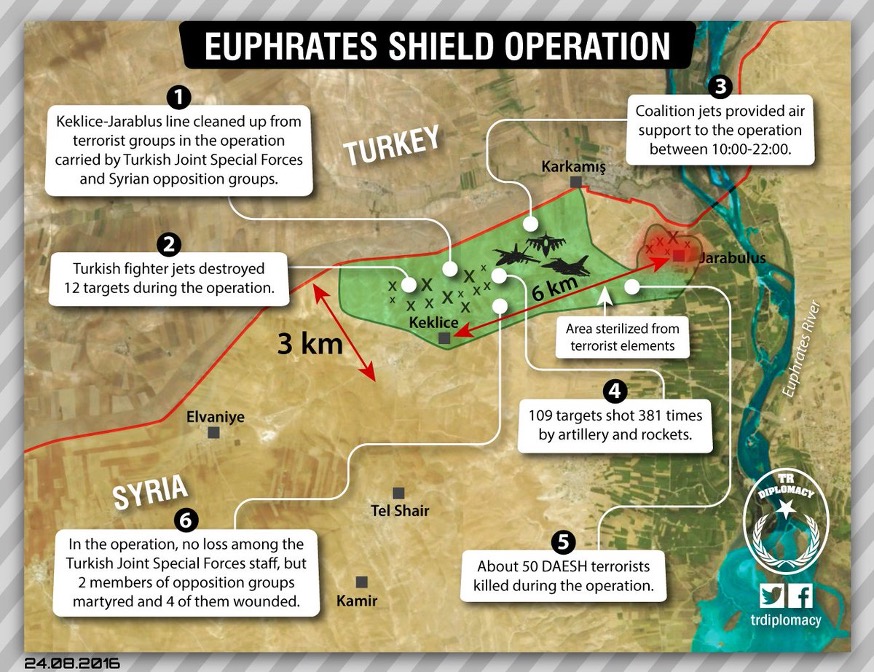
The military operation was launched on the base of alliances and support of “the local ally” which is Free Syrian Army (FSA).[1] In that regard, Turkish Military Forces conducted the operation with the support of actors which had detailed local knowledge. Moreover, these actors operated the process in a certain harmonization. According to Yeşiltaş, Seren and Özçelik,
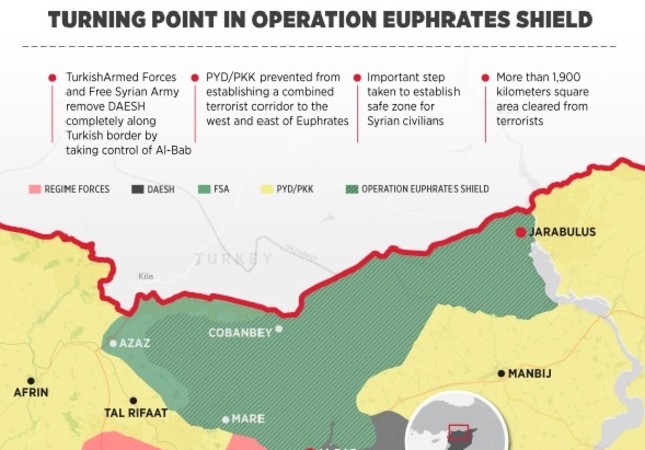
The operation consisted of four main phases in line with the Article 51: the Jarablus – Sajur Phase (August 24-28, 2016), The Çobanbey (Rai) and Dabiq Phase (September 3 – October 16, 2016), The Dabiq – Al-Bab Phase (October 17 – December 20, 2016), The Al-Bab Phase (December 21, 2016 – March 30, 2017). The first phase, which is launched “under the fire support of medium-range artillery and multiple-launch rocket systems (MLRS)”, ended with certain gains and effective tactics. This phase was targeting DAESH/ISIS and YPG/YPG elements in different places and these terrorist organizations were mostly damaged. Moreover, it tested the maneuvering capability of Turkish Forces against DAESH/ISIS and YPG/YPG. However, Turkey faced the international reactions. Therefore, in this phase, it can be indicated that these terrorist organizations’ potential relies on “anti-tank rockets and dynamic small unit tactics”. Secondly, this phase mainly targeted the town of Çobanbey and its nearby villages. In this phase, DAESH/ISIS’ anti-tank mechanisms posed a certain threat for Turkey, which had not been realized at the beginning of the operation. However, military units remained its vulnerability to “anti-tank threats from DAESH”. In the second phase, it is nor wrong to say that DAESH failed to defend themselves against OES forces because forces have “high fire power and maneuvering capability”. In that regard, DAESH elements lost more territory and they had to defend their position in smaller areas. Thus, Turkey captured these places and deployed its military units to the Çobanbey area in September 2016. Moreover, anti-DAESH Coalition air forces supported Turkey, which puts Turkey into a powerful situation. This phase was more successful than the first one. Lastly, the third phase is the one where the OEC’s main aim is capturing al-Bab. They attempted on December 21, 2016. Turkish military officials, thus, completed this operation on March 30, 2017. Turkey was successful to push DAESH elements “40 kilometers southward and forming a buffer zone between the border of Turkey and the dreamed YPG/PKK corridor”. After Turkey’s success, the safe zone (90 kilometers in length and 40 kilometers in depth) was created and north of Syria was taken under control. Nevertheless, Turkey’s conditions on pushing YPG/PKK elements were not fully met because of the American backing this terrorist organization.
Turkey has focused on Syria’s territorial integrity, stability and safety. In that regard, terrorist organizations deployed in this country has always pose a threat for the regional stability. While DAESH/ISIS terror attacks were increasing and more Syrians were suffering, Turkey launched the military operation under the UN Charter Article 51. The press release stated on Nov 30, 2016 by the UN Security Council, Turkey’s main aims were to “maintain border security and confront Daesh terrorism”; also, Turkey stated that its combat would continue against its affiliates (YPG/PYD) to prevent a corridor on Turkey’s border.[2] Thus, Turkey successfully concluded Operation Euphrates Shield by clearing the broaden place from DAESH threats and providing a safe place for the Syrian people’s return. Moreover, Turkey delivered necessary assistance for those suffered people and helped create a place without extremism and radicalism. Turkey will continue to be actively involving in all international initiatives and operations in order to consolidate long-lasting peaceful environment, stability and prosperity in the region. Also, it always be against radicalism, extremism, violence and volatility in Syria and its neighbors.
[1] Yesiltas, Murat, Merve Seren, and Necdet Özçelik. “Operation Euphrates Shield Implementation and Lessons Learned.” SETA Foundation for Political, Economic and Social Research (2017), p. 22.
[2] Ülgen, S., and C. Kasapoğlu. “Operation Euphrates Shield: Aims and Gains”, Carnegie Europe (2017).
 TURKEY'S FIGHT AGAINST DAESH/ISIL