Non-state armed groups have been increasingly inciting civilians and strengthening their illegal structure through their own procedures which are applied during recruitment and posing core threats for countries. As a result of this broadening recruitment and network, increasing number of people have joined terrorist groups. Thus, those who use fraudulent documents while reaching their target country pose a certain threat.
This concept has gained an importance since the declaration of “so-called Islamic State (DAESH/ISIS)”. This terrorist organization has been shaped under religious motives. In a short time, it has a constant stream of foreign jihadist fighters as a result of its Salafist jihadist ideology. This ideology has heavily threatened the globalized and civilized world regardless of ethnicity, religion and national origin. In that regard, DAESH/ISIL has a potential to inspire “a new generation of jihadist terrorists”, which triggers the security threat to many countries.
Following certain threats posed by those leaving their home to join terrorist organizations, the concept of “foreign fighters” was transformed into “foreign terrorist fighters”. These two concepts are legally different from each other. While “foreign fighter” is not a legal term because it is not defined in treaties and international law, “foreign terrorist fighters” is defined in the UN Security Council Resolutions 2170 and 2179 which are adopted under Chapter VII of the UN Charter.[1] According to Resolution 2178, “foreign terrorist fighters” are those who are traveling to the third countries for the purpose of planning and participation in terrorist acts as well as receiving of terrorist training.[2] the UN Security Council chose to describe foreign fighters – or at least some of them – as “Foreign Terrorist Fighters”. In this resolution, FTFs are “…. nationals who travel or attempt to travel to a State other than their States of residence or nationality, and other individuals who travel or attempt to travel from their territories to a State other than their States of residence or nationality, for the purpose of the perpetration, planning, or preparation of, or participation in, terrorist acts, or the providing or receiving of terrorist training, including in connection with armed conflict.”.[3] Thus, this resolution has a significant role for countries to shape security policies in their combat against terrorism. Moreover, according to this definition, those who are named as a “foreign terrorist fighter” can also have a strong bond with the terrorist organizations without organizing armed attacks.
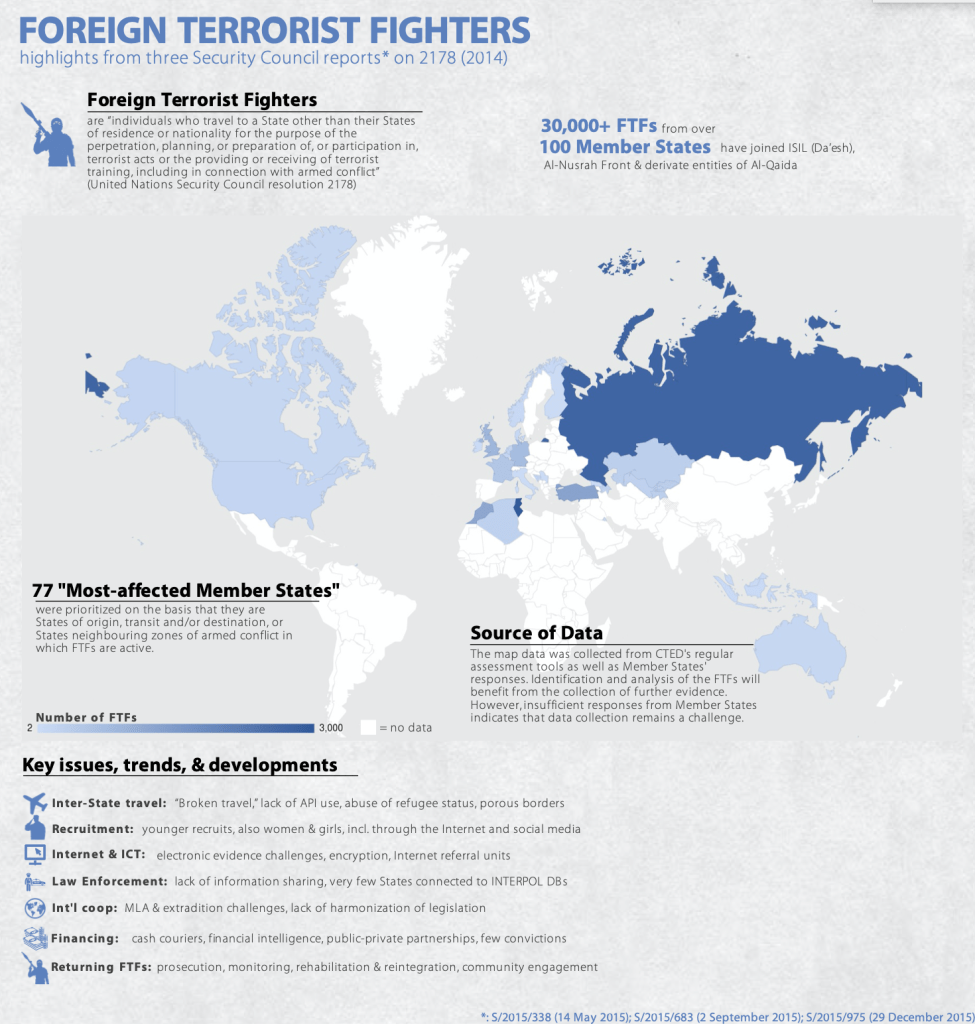
Those leaving their hometown in order to be a part of the terrorist organizations have posed a security threat because of not only capabilities of carrying out terrorist attacks but also disseminating radical ideology. Particularly, Syrian and Iraqi regimes are not able to stabilize power vacuum which creates an appropriate environment for terrorist organization. Under these circumstances, more and more countries have been worried FTFs will organize terrorist attacks outside of the two countries. Therefore, other countries have adopted joint decisions and taken common precautions when brutal attacks have taken place in their cities. For example, countries do heavily focus on preventing designation of FTFs while DAESH/ISIS are recruiting more fighters. In that regard, the UN Security Council Resolution 2178, as a major step “bringing a measure of uniformity into individual state actions against terrorism” explaining the measures: freezing the assets of foreign terrorist fighters, following their destination and transit countries, establishing control points, sharing intelligence among countries and forming non-entry lists.[4] Since the resolution was unanimously adopted, more than 30 countries have been coming together to take measures which are expressed in the previous sentence. In that regard, transition of the concept from “foreign fighters” to “foreign terrorist fighters” is significant in terms of creating a capability to implement legal procedure. After gaining legal position thanks to the resolution, countries have a right to judge FTFs according to their laws. According to resolution 2178, UN member states are obliged to exert efforts to prevent recruiting, equipping, transporting as well as organizing FTFs, the financing of FTF activities.[5]
To conclude, DAESH/ISIS has posed a significant threat because of rising number of its followers and broadening network. As a result of this broadening network, those coming from origin country is becoming more common. In that regard, countries have highlighted this threat. Under these circumstances, the UN member countries which have named those as “foreign terrorist fighters”, have been still struggling with certain challenges. These include “the collection, preservation, and sharing of evidence obtained in conflict and post-conflict settings”; moreover, The CTC under the UN umbrella has regularly held meeting where they focused on these challenges relating to prevention of FTF flow.[6] In these meetings, the significant step was taken through the UN Security Council Resolution 2178 which has enabled the definition and prosecution of FTFs. Thus, countries have been able to come together around a certain explanation of terrorist fighters.
[1] Bílková, Veronika. “Foreign Terrorist Fighters and International Law”, Groningen Journal of International Law 6.1 (2018): 1-23.
[2] Bílková, Veronika. “Foreign Terrorist Fighters and International Law”, Groningen Journal of International Law 6.1 (2018): 1-23.
[3] United Nations Security Council, Resolution 2178 (2014): Adopted by the Security Council at its 7272nd meeting, on 24 September 2014, S/RES/2178 (2014), www.un.org/en/sc/documents/resolutions/2014/shtml.
[4] Lynch, Dennis. “What Are Foreign Terrorist Fighters? UN, World Leaders Resolve To Stop Western Terrorists”, International Business Times,https://www.ibtimes.com/what-are-foreign-terrorist-fighters-un-world-leaders-resolve-stop-western-terrorists-1695599.
[5] Schmid, Alex P., and Judith Tinnes. “Foreign (Terrorist) Fighters with IS: A European Perspective.” The International Centre for Counter-Terrorism–The Hague 6.8 (2015): 1-68.
[6] “Counter-Terrorism Committee holds briefing on returning foreign terrorist fighters”, United Nations Website, https://www.un.org/sc/ctc/news/2017/11/08/counter-terrorism-committee-holds-briefing-returning-foreign-terrorist-fighters/
 TURKEY'S FIGHT AGAINST DAESH/ISIL