Turkey, as a neighbor of the place where DAESH/ISIS was founded, is one of the countries which have been targeted by this terrorist group. It is also one of the main countries which have been executed by terrorist attacks the most. In five cross-border assaults, and six suicide bombings attacks, which was taken place from March 2014 to March 2016, 163 people were killed in total and more than 766 people were wounded.[1] However, the most intense terrorist attacks was taken place in 2016 while the number of FTFs have been sharply increasing.
[1] Yalçınkaya, Haldun. “Turkey’s Struggle Against the Foreign Terrorist Fighters of DAESH”, Perceptions: Journal of International Affairs 21.1 (2016): 27-44.
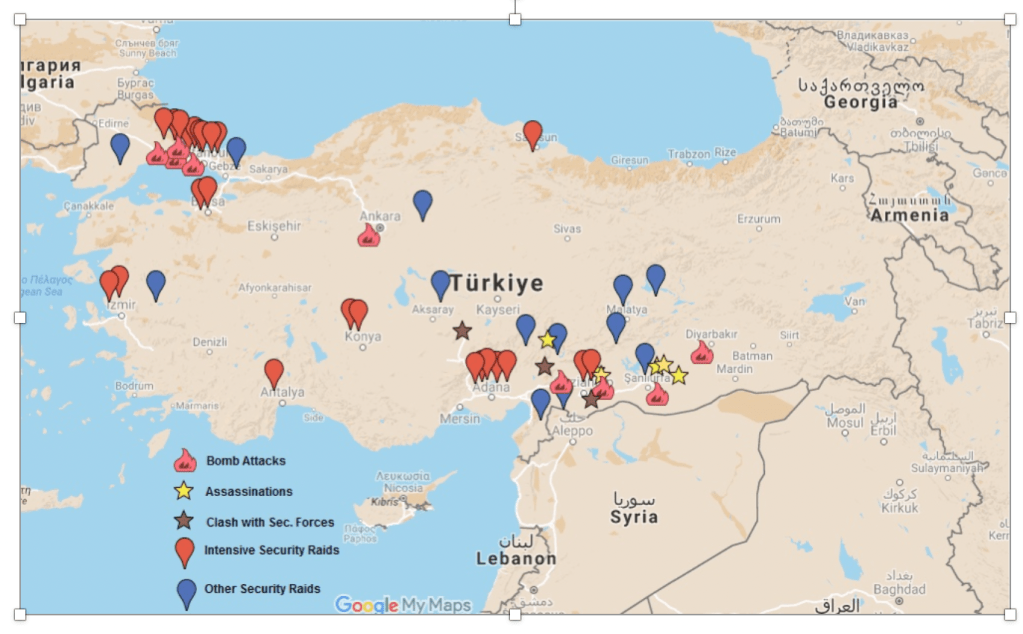
[1] Yeşiltaş, Murat & Öncel, Rıfat and Öztürk, Bilgehan. (2016). Turkey’s Fight Against DAESH. SETA Rapor. No: 63. İstanbul: Turkuvaz Haberleşme ve Yayıncılık, p.12
The main motivation of DAESH/ISIS attacks in Turkey was “its decentralization strategy” which means the mobilization of DAESH/ISIS terrorists from Syria and Iraq to Turkey with the aim of creating new cells in the country.[1] According to DAESH/ISIS’ changing terrorist groups’ “micro-mobilization” strategy, “DAESH aims at localizing itself in Turkey not in the form of controlling a territorial part but in the way of consolidation of the pro-DAESH discourses”.[2] Therefore, the number of terrorist attacks which have been planned by DAESH/ISIS sharply increased in this period as a result of its changing strategy. Particularly, the biggest terrorist attacks conducted by this terrorist organization is the Atatürk Airport Attack of June 28, 2016. This was the mile-stone in Turkey’s security policy and the level of threat which is posed by this terrorist group. Following the attack, it is realized that FTFs which are coming from other countries has been posed a certain threat for Turkey. In this terrorist attack, there were “the multi-national characteristics of FTFs”. Under these circumstances, Turkey has been focusing on FTFs more since this sounding terrorist attack. Moreover, it has launched international cooperation to prevent this kind of attacks. According to Yalçınkaya,
When DAESH/ISIS attacks and timing analyzed, it could be argued that their targets have been selected in Turkey according to the agenda of the time period. Moreover, Turkey which have an intense Muslim population is an appropriate country to be a target of this terrorist group. When they are not able to recruit many people in Turkey, they prefer to attack with the help of FTFs coming from other countries. Under these circumstances, returnee FTFs have been posing a high threat for Turkey in both reality and theory.[3]
In 2016, DAESH/ISIS skyrocketed its terrorist attacks in Turkey. Moreover, Dabıq Magazine which has been published by this terrorist organization has attached great importance to İstanbul. According to statistical data, “the number of detained foreign nationals skyrocketed after April 2016 from 3 in April to 25 in May, 38 in June, and 76 in July”.[4] This happens because of the two main reasons: detecting the possible Turkish FTFs and eliminating those, Turkish military operations putting DAESH/ISIS in a challenging position. Both are related to Turkey’s successful security policies and certain measures. Especially, military operations conducted in Syria and Iraq have forced this terrorist organization; thus, it lost huge amount of its territory. Another sounding attack in 2016 is the suicide bombing in Sultanahmet and Taksim. This member of DAESH/ISIS killed 10 people, including 8 German tourists. As DAESH/ISIS attacks are explained in the second chapter, the more DAESH/ISIS attacks have been taken place in Turkey the more pressure has been put on this terrorist group.
Turkey has been the target of DAESH/ISIS for years. Its location is one of the reasons as a result of high amount of FTFs using Turkey as a transit country. Moreover, they are able to organize terrorist attacks while passing from this country or when they stuck in Turkey. On the one hand, Turkey has intensified its security policies, detentions and measures. On the other hand, DAESH/ISIS has increased its attacks’ sphere of influence and amount. In this vein, the year, 2016, is categorized as a time period when DAESH/ISIS attacked Turkey the most. As it is mentioned in the previous paragraph, the attacks were taken place between 2014 and 2016 are the main indicators to argue the certain spread of the radicalization and violence caused by DAESH/ISIS through FTFs having different origins. However, Turkey successfully stopped this terrorist groups’ attacks through strong measures.
[1] Yeşiltaş, Murat & Öncel, Rıfat and Öztürk, Bilgehan. (2016). Turkey’s Fight Against DAESH. SETA Rapor. No: 63. İstanbul: Turkuvaz Haberleşme ve Yayıncılık. p.13
[2] Yeşiltaş, Murat & Öncel, Rıfat and Öztürk, Bilgehan. (2016). Turkey’s Fight Against DAESH. SETA Rapor. No: 63. İstanbul: Turkuvaz Haberleşme ve Yayıncılık. p.13
[3] Yalçınkaya, Haldun. “Turkey’s Struggle Against the Foreign Terrorist Fighters of DAESH”, Perceptions: Journal of International Affairs 21.1 (2016): 27-44.
[4] Yeşiltaş, Murat & Öncel, Rıfat and Öztürk, Bilgehan. (2016). Turkey’s Fight Against DAESH. SETA Rapor. No: 63. İstanbul: Turkuvaz Haberleşme ve Yayıncılık. p.13
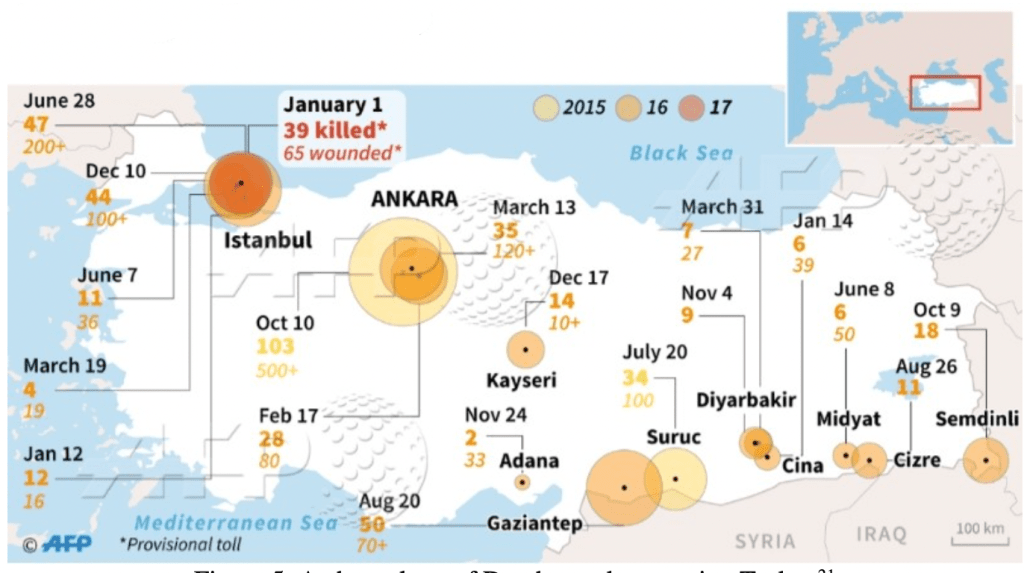
[1] “A chronology of Daesh attacks targeting Turkey”, Daily Sabah Newspaper, (1 January 2017). Retrieved from, https://www.dailysabah.com/war-on-terror/2017/01/01/a-chronology-of-daesh-attacks-targeting-turkey
 TURKEY'S FIGHT AGAINST DAESH/ISIL