The violent non-state actors (VNSA) use violence to accomplish their goals, whether these goals are motivated by religion, ethnicity or ideology. These actors are formed in a very local or sub-regional context as a result of failed states, such as Iraq and Syria. In this regard, the Islamic State of Iraq and al-Sham (DAESH/ISIS) represents the primary terrorist groups of concern to the world because of its brutal terrorist attacks.
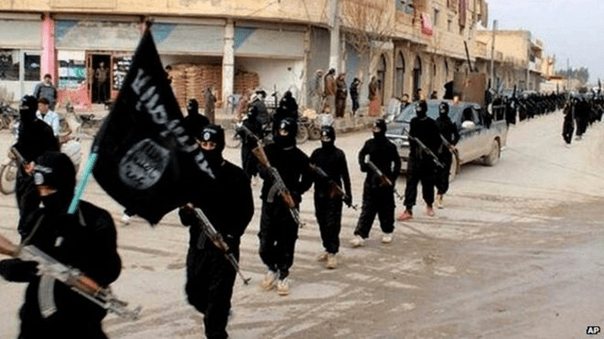
ISIS-led Sunni rebels have seized large swathes of north-Western Iraq and Syria (BBC).
Abu Musab al-Zarqawi settled the radical criminals and organized those people while in prison to smuggle messages of Zarqawi out to be disseminated through prominent Salafi websites.[1] After Abu Musab al-Zarqawi was released in 1999, he went to Afghanistan and came together with Osama bin Laden who was Al Qaeda (AQ) leader; however, the ideological differences and disagreements appeared.[2] While Abu Musab al-Zarqawi was focusing on his near enemies, Osama Bin Laden was targeting distant ones.[3] Another disagreement was the perception on Shiites which Abu Musab al-Zarqawi hatred; however, it is asked to join Al Qaeda.[4] It is refused by Abu Musab al-Zarqawi. Under these circumstances, militants living in Afghanistan were trained by Abu Musab al-Zarqawi in Herat camp. Therefore, it had a room to spread its ideology across the world. Starting from the 2001 American invasion of Afghanistan, the terrorist organization’s followers have been under transformation in terms of their ideology and attack types.
[1] Weaver, Mary Anne. “The Short, Violent Life of Abu Musab Al-Zarqawi.” The Atlantic, August 2006.
[2] Bergen, Peter, Joseph Felter, Vahid Brown, and Jacob Shapiro. Bombers, Bank Accounts, & Bleedout: Al-Qa’ida’s Road In and Out of Iraq. Rep. Ed. Brian Fishman. Combatting Terrorism Center at West Point, July 2008. Web. 22 Dec. 2014.
[3] Ibid.
[4] Kirdar, MJ. AQAM Futures Project Case Studies Series: Al Qaeda in Iraq. Publication. Center for Strategic and International Studies, June 2011. Web. 24 Nov. 2014. p.3.

The peace which is the message given by Islamism is destroyed by DAESH/ISIS. This teroris organization’s practices are based on Wahhabism.
Following the 2001 American invasion of Afghanistan and apprehension of the American invasion of Iraq, the group became to be transferred to Iraq. Between the periods from 2003 to 2007, the terrorist organization escalated the insurgency in Iraq till its brutal attacks reversed its popularity among its followers.[1] Under these circumstances, they assumed the name of Al Qaeda in Iraq (AQI) in 2004 after swearing on their fealty to Al Qaeda. As a result of these escalated terrorist attacks and changing ideology as well as newly emerging tactics led to a period of decline. This period is escalated by the death of Zarqawi in 2006. Thus, his followers who were the major participants in the Iraqi rebellion became a major threat for stability in Iraq after his death.
Following his death, AQI declared that his successor would be Abu Ayub al-Masri who was the “Egyptian bomb-maker” would be the successor of him.[2] However, this change in leader position did not prevent the decline of its power and prestigious. In that regard, the terrorist group experienced the decline until 2011 when the American troops were withdrawal from Iraq and started the Syrian Civil War.[3] In Syria, the main reason of the reemergence of AQI was the power vacuum created by instability and fragility in the country. In other words, the power vacuum in Syria was filled by AQI. Following the Syrian civil war and rapid reemergence of this terrorist organization in Syria, it changed its name and formed the Islamic State in Iraq and Syria (ISIS). [4] After its foundation in Syria, they began to seize territory and extent its influence zone in both Iraq and Syria under the leadership of Abu Bakr al-Baghdadi. Three years after the Syrian civil war started, they stated their caliphate establishment in the two countries, in June 2014.
[1]Kirdar, MJ. AQAM Futures Project Case Studies Series: Al Qaeda in Iraq. Publication. Center for Strategic and International Studies, June 2011. Web. 24 Nov. 2014. p.3
[2] Kaplan, Eben. “Abu Hamza Al-Muhajir, Zarqawi’s Mysterious Successor (aka Abu Ayub Al-Masri).” Council on Foreign Relations. 13 June 2006. Web. 26 Nov. 2014.
[3] Mapping Militant Organizations. “The Islamic State.” Stanford University. Last modified September 2019. https://cisac.fsi.stanford.edu/mappingmilitants/profiles/islamic-state
[4] Mapping Militant Organizations. “The Islamic State.” Stanford University. Last modified September 2019. https://cisac.fsi.stanford.edu/mappingmilitants/profiles/islamic-state
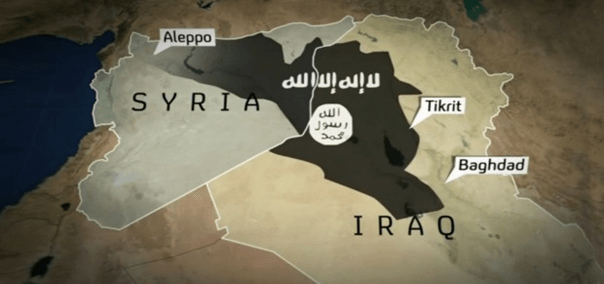
Syrian and Iraqi fighters declared the “caliphate” establishment”, referring to the system of rule that ended nearly 100 years ago with the fall of the Ottoman empire. (http://mwcnews.net)
DAESH/ISIS has a distinctive character from the previous terrorist organizations in the way of adopting two political tools: both violence and the media means.[1] Both have been turned into propaganda tools, as well. As it is commonly accepted, the terrorist organization has used the violence as the tool to disseminate his ideology. Moreover, DAESH/ISIS prefers to practice taqfir, which is the declaration of someone known to be a Muslim as an infidel. Thanks to the practice of taqfir, DAESH/ISIS aims to provide certain social practices and adapt to those who should be seen as “others”; therefore, it is not wrong to say that DAESH/ISIS’s ultimate goal is to legitimize the violence applied by them.[2]However, the taqfir that they practice is incoherent with the meaning of Qu’ran, and hadits, as well as sunnah. In that regard, Turkey has assumed a significant responsibility through issuing fatwas on combating DAESH/ISIS. In other words, as a response to the Taqfir of DAESH, fatwas that challenge and counter DAESH/ISIS are issued.
In the security literature, there are only two scholars who have focused on the role of fatwas in countering DAESH/ISIS: Schmuel Bar and Gabriel Weimann conducting surveys to explain the importance of fatwas in terrorism. The former one argues that there is a strong link between fatwas and terrorism through his citations on the modern Islamist jihad movement starting from 1980s when the increase of fatwas’ importance was on the agenda.[3] In accordance with Schmuel Bar, the fatwas which are issued on terrorism addressed a wide range of issues from the definition and characterization of the battle space, the necessary of jihad, the character of the “infidels”, the reason of participation in jihad, its legitimate meaning to the legitimacy of suicide attacks and other issues.[4] The latter one asserts that the similar ideologies that the use of fatwas is “a major instrument in bridging current terrorism and religion.”[5] This terrorist organization has used this practice of taqfir to justify “the use of suicide terrorism, the killing of innocents, the killing of children and women, the killing of Muslims or the use of various weapons (including weapons of mass destruction and cyber terrorism”.[6] In that regard, Turkey’s Directorate of Religious Affairs (Diyanet) represents a significant actor in the fight against DAESH/ISIS. It provides information on religion which is politicized by the terrorist organization. Therefore, the right information about religion is able to be disseminated on public. These messages given by Turkey’s Directorate of Religious Affairs are to emphasize the peaceful and tolerant policies of Islam through countering extreme violation. Islam also promotes the unity among people regardless of their different beliefs.
[1] Salihi, Emin, (2019). “Işid, Şiddet ve Propaganda: En-Nebe Dergisi İncelemesi”, Ömer Halisdemir Üniversitesi İktisadi ve İdari Bilimler Fakültesi Dergisi, 12(3), p.400.
[2] Salihi, Emin, (2019). “Işid, Şiddet ve Propaganda: En-Nebe Dergisi İncelemesi”, Ömer Halisdemir Üniversitesi İktisadi ve İdari Bilimler Fakültesi Dergisi, 12(3), p.400.
[3] Bar, Shmuel, “Jihad Ideology in Light of Contemporary Fatwas,” Muslim World, The, no. 1 (2006): 1, http://www.hudson.org.
[4] Bar, Shmuel, “Jihad Ideology in Light of Contemporary Fatwas,” Muslim World, The, no. 1 (2006): 1, http://www.hudson.org.
[5] Weimann, Gabriel, “Cyber-Fatwas and Terrorism,” Studies in Conflict & Terrorism 34, no. 10 (2011): 766, doi:10.1080/1057610X.2011.604831
[6] Weimann, Gabriel, “Cyber-Fatwas and Terrorism,” Studies in Conflict & Terrorism 34, no. 10 (2011):769, doi:10.1080/1057610X.2011.604831
Turkey, as the leading country in this fight against DAESH/ISIS, has been practicing counter-terror fatwas since this terrorist organization was formed. Those fatwas are the instrument to explain Islam and refute this terror organization’s arguments that “the Islamic legitimacy of violence used for political ends”.[1] In that regard, Turkey’s Directorate of Religious Affairs (Diyanet) has intensely disseminated fatwas in order to prevent terror attacks and enlighten the public to be more active against violent extremism and radical terrorism. Also, Turkey has been countering DAESH through not only practicing fatwas but also disseminating reports. Turkey’s Directorate of Religious Affairs (Diyanet) has released reports that explain the noteworthy threat which is posed by this terrorist organization. Turkey has been highly critical of DAESH/ISIS by denouncing its terror attacks and actions. It characterizes DAESH/ISIS as the twisted portrayal of Islam and Qur’an. Turkey’s Directorate of Religious Affairs (Diyanet) has also described DAESH/ISIS’s character as a brutal portrait of extremism and radicalization.[2] While portraying their character, this terrorist organization utilizes social media in order to disseminate its threat across the world. It is well known for disseminating the disturbing videos on the internet. Moreover, DAESH/ISIS, as the terrorist organization that most efficiently uses the social media, have their own online magazines. These are Dabiq and Konstantiniyye which are publishing particular news on Istanbul. They especially make their propaganda through social media platforms, such as Twitter, Telegram as well as Youtube. They are able to gain and recruit certain followers through their social media websites. In response to the rise of this terror organization, Turkey carefully follows its websites and social media platforms and has banned their media accounts as well as websites. Under these circumstances, Turkey has also intensely removed the content which supports and encourages terror activities. As a result of Turkey’s efforts, DAESH/ISIS has been facing pressure both on the military front and on the social media platforms.
[1] John L Esposito, What Everyone Needs to Know about Islam, 2nd ed. (New York: Oxford University Press, 2011), p. 166–67.
[2] Exploitation of religion and extremist terrorist organization DAESH”, Diyanet (21.11.2017), p. 48-49. Retrieved from, https://dosya.diyanet.gov.tr/DIYKDosya/YayinDosya/94342976-b84f-495c-b7bc-d8a32498d6a4.pdf

To conclude, DAESH/ISIS is a terrorist organization which aims to establish a caliphate of Islam in Iraq and Syria as well as extend its influence.[1] As a result of increasing number of foreign terrorist fighters, its influence is getting spreading globally. In that regard, Turkey, as a country deeply effected by terror attacks, has exerted utmost efforts to prevent dissemination of DAESH/ISIS’ ideology. It is the country that counters DAESH/ISIS not only on the field but also under the umbrella of new technologic developments. In this context, Turkey implements the acts towards DAESH/ISIS such as recognizing it as a terrorist organization, applying criminal sanctions, closing its followers’ social media accounts, preventing to reach their online magazines. In other words, terrorist attacks imposed by DAESH/ISIS which has urged Turkey to take necessary measures both inside and outside the country initiated simultaneously with its formation.
 TURKEY'S FIGHT AGAINST DAESH/ISIL